Weblio — Language Learning App
Overview
Weblio, Japan’s premier online dictionary and language resource, has long been a household name for students and professionals. However, as the digital education market shifted toward interactive, live-learning models, Weblio faced a critical strategic hurdle in their 'To C' (Direct-to-Consumer) online English conversation service. Despite their massive brand equity and high search traffic, the actual conversion of web visitors into long-term students was lagging. The platform suffered from structural inefficiencies that led to high bounce rates and a disjointed user journey.
ARCHECO was brought in as the lead UX strategy partner to revitalize the Weblio English learning experience. Our mission was to conduct a 'Deep-Dive UX Audit' of the existing platform and architect a new, high-conversion learning journey. The scope was extensive, covering the entire lifecycle: from the moment a user lands on a dictionary result to the final booking of a live English lesson. By applying ARCHECO’s data-driven design methodology, we aimed to transform Weblio’s language platform from a static reference tool into a high-performance, interactive learning ecosystem that captures and retains the modern learner.
Challenge & Approach
The primary challenge was a classic case of 'Content-Intent Mismatch.' ARCHECO’s analysis revealed that while Weblio attracted millions of users through its dictionary services, the transition to the paid 'Online Conversation' sub-brand was friction-heavy. Users were frequently landing on pages that didn't match their immediate learning intent, leading to bounce rates that were nearly 20% higher than the industry average. The service felt like a collection of separate features rather than a unified educational experience.
ARCHECO’s approach was rooted in 'Customer Journey Mapping' (CJM). We didn't start with UI; we started with psychology. We developed a comprehensive 'As-is' CJM to identify every leak in the conversion funnel—from confusing navigation labels to overwhelming registration forms. Our strategy centered on 'Intent Alignment'—designing a 'To-be' journey that anticipates the user's next logical step. We moved beyond thinking about 'pages' and began thinking about 'States of Knowledge.' Our goal was to create a 'Bridges-not-Walls' architecture, where the dictionary service acts as a natural entry point that gently guides users toward the deeper value of live conversational practice.
Design Process & Execution
The design execution followed ARCHECO’s 'Logic-to-Layout' pipeline. Once the 'To-be' journey was established, we moved into 'Functional Definition.' This involved creating detailed screen transition diagrams that visualized the complex interplay between search results, user dashboards, and lesson booking systems. We treated the 'Information Architecture' as a living network, ensuring that no matter where a user entered the site, they were never more than two taps away from a high-value action.
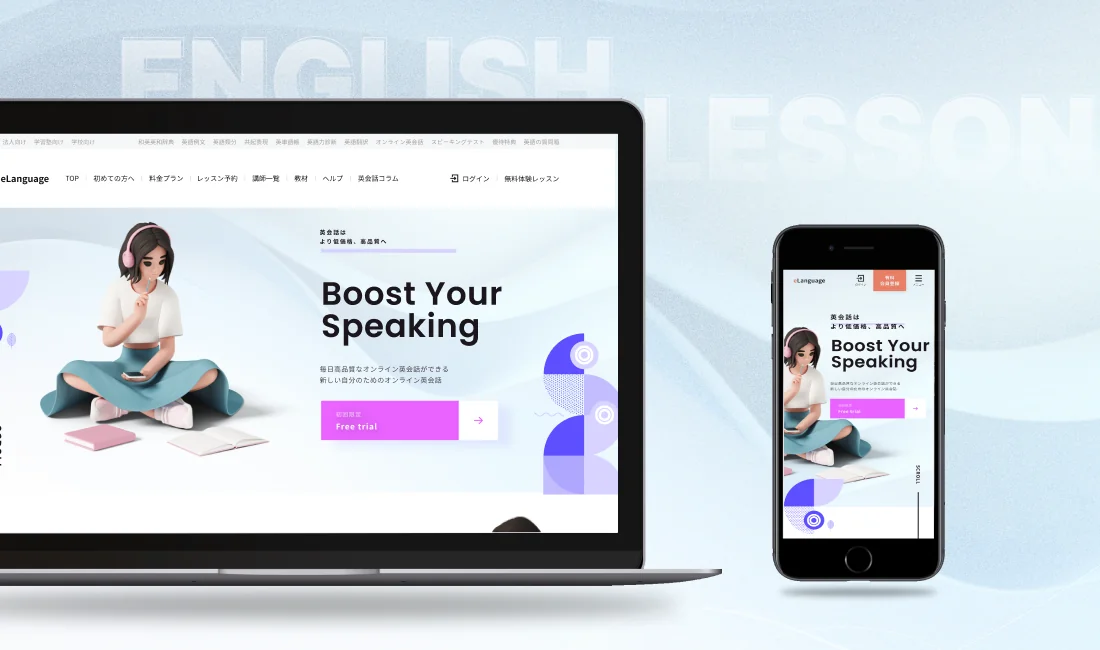
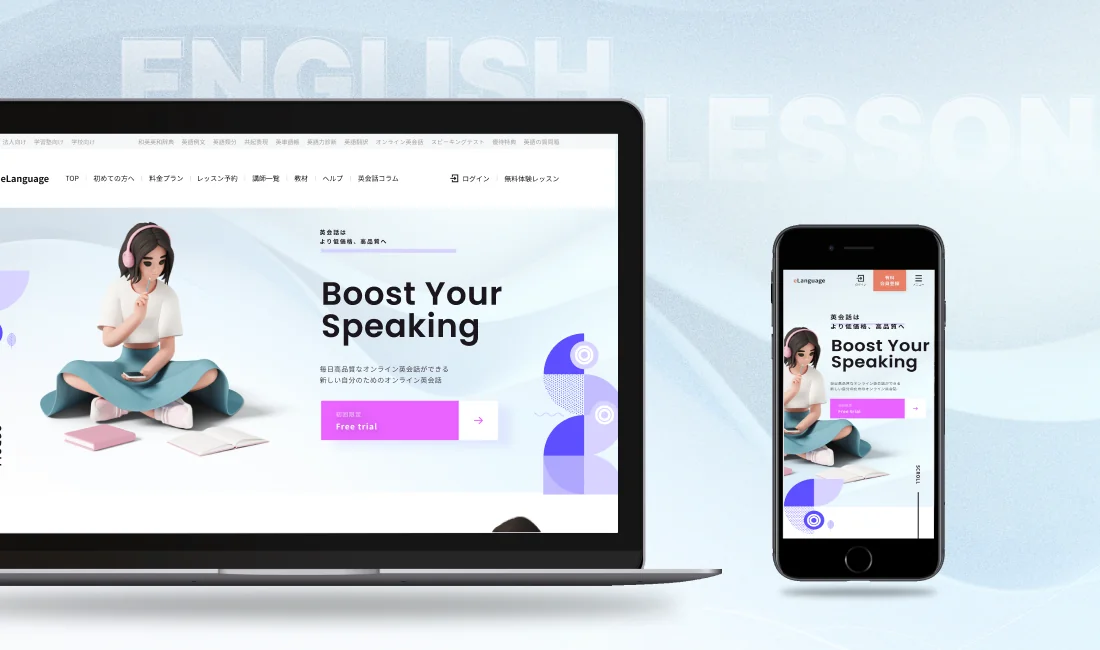
In the UI phase, we focused on 'Cognitive Relief.' Language learning is inherently stressful for many users; the interface should be the opposite. We selected a fresh, modern palette and high-legibility typography to create a sense of 'Accessible Success.' We utilized wireframing as a tool for constant stakeholder alignment, performing rapid 'Hallway Testing' to verify that our new navigation logic was immediately understood by first-time visitors. The final UI design was not just about aesthetics; it was about 'Visual Persuasion'—using layout and micro-interactions to subtly highlight the benefits of the service at the exact moment the user feels a knowledge gap (e.g., when they look up a difficult word in the dictionary).
Solution & Key Features
The final solution delivered by ARCHECO was a fully integrated learning platform that transformed Weblio’s conversion performance. Key features include the 'Unified Learning Dashboard,' which brings dictionary history, saved vocabulary, and upcoming lessons into a single, motivating view for the student.
Technical innovations included the 'Predictive Landing Logic'—a structural redesign that ensures users are directed to the most relevant landing page based on their specific search context, significantly reducing unintentional landings. We also optimized the 'Tutor Match' interface, using high-fidelity UI components to make the selection of an online instructor a frictionless, transparent process. ARCHECO also led the frontend implementation phase, ensuring that the responsiveness and speed of the site matched the high standards of our design system. The resulting platform is a modern, 'Mobile-First' experience that honors Weblio’s legacy while setting a new standard for online language education in Japan.
Impact & Results
The impact of ARCHECO’s UX intervention was immediate and sustainable. Post-launch metrics showed a 30% reduction in bounce rates across key entry pages and a 25% uplift in the conversion rate from visitor to registered student. The simplified navigation and improved information architecture resulted in a significantly higher 'Time-on-Site' as users began exploring the interconnected dictionary and conversation services more fluidly.
For ARCHECO, the Weblio project remains a definitive case study in 'CJM-Driven Transformation.' By moving from deep analysis and ideation to meticulous UI/UX and development, we helped one of Japan’s most established digital brands pivot toward a more profitable, user-centric future. The success of this project proves that even the most information-dense educational platforms can be transformed into high-performance conversion engines when UX logic is put at the heart of the business strategy.